Shopify vs Custom Ecommerce in Belgium: 2026 Comparison
Shopify is a good fit for testing a market quickly: roughly $29 to $399 per month, plus paid apps and 0.6 to 2% transaction fees outside Shopify Payments. A custom-built ecommerce site requires a higher upfront investment but removes platform fees and stabilizes your total 3-year cost. WooCommerce remains relevant if you have WordPress skills in-house. The right choice depends on your order volume and specific needs.

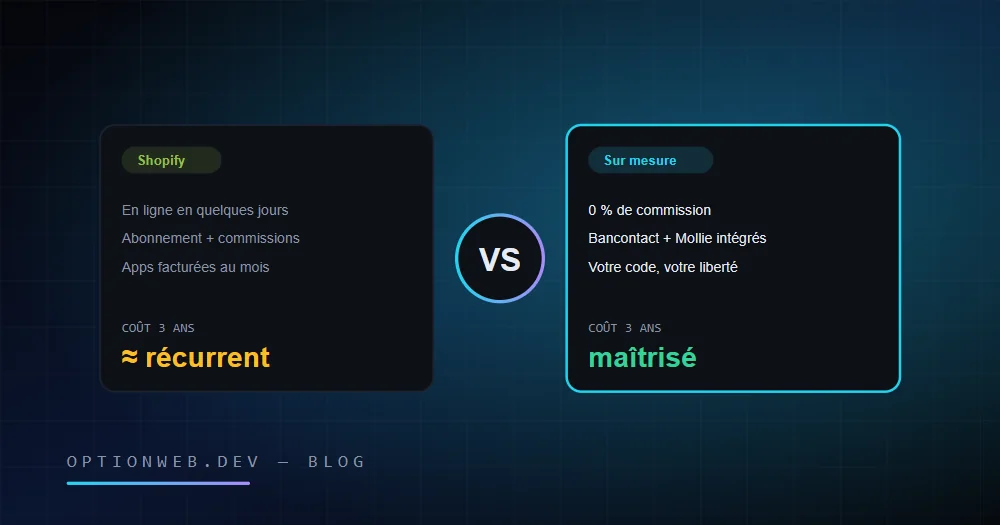
Shopify is the best choice for testing a market quickly on a limited starting budget; a custom-built ecommerce site is the best choice for a brand that is scaling, wants zero commission and needs specific functionality. Shopify costs roughly $29 to $399 per month depending on the plan, plus apps and possible transaction fees. A custom site costs more upfront, but its total 3-year cost often ends up lower once order volume starts to climb.
The Belgian market makes this a question worth taking seriously. According to the BeCommerce Market Monitor, Belgians spent more than 16 billion euros online in 2024. And according to Statbel, around three quarters of Belgians aged 16 to 74 now shop online. The competition is real: your platform choice shapes your margins, your speed and your freedom for years to come.
This article is a solution comparison and a decision aid: Shopify, WooCommerce, custom-built. For the full step-by-step of a launch (products, logistics, marketing), see our guide to creating an ecommerce website in Belgium in 2026. Here, we focus on numbers, store profiles and the signals that tell you it is time to switch.
1. What does Shopify really cost in Belgium?
Shopify costs between roughly $29 and $399 per month in subscription fees, but the real cost of an active Belgian store sits closer to €100 to €400 per month once apps, the theme and transaction fees are counted. The subscription is only the visible part: charging for the ecosystem around it is Shopify's business model.
Shopify is a SaaS platform: you rent the technology, you never own it. The three main plans are Basic (around $29/month billed annually), Grow (around $79 to $105/month) and Advanced (around $299 to $399/month). Prices are in dollars and change regularly — Shopify has raised its rates several times in recent years.
- Monthly subscription — Roughly $29 to $399/month depending on the plan. The Basic plan is enough to get started; advanced reports and calculated shipping rates quickly push you towards Grow or Advanced.
- Premium theme — The free themes are decent but very widely used. A premium theme costs around $200 to $400 as a one-off purchase, plus the cost of customization by a specialist if you want to stand out.
- Paid apps — Customer reviews, FR/NL translation, compliant Belgian invoicing, advanced SEO, bundles: every building block is an app at $10-50/month. A typical Belgian store racks up €50 to €150/month in apps.
- Transaction fees — If you use an external payment provider such as Mollie, Shopify takes roughly 0.6 to 2% per transaction depending on the plan, on top of the provider's own fees. With Shopify Payments that fee disappears, but processing costs remain (around 1.9 to 2.9% plus a fixed fee per card).
Run the numbers on your own volume. A store taking €15,000 per month through an external provider pays €90 to €300 in monthly Shopify fees — before the payment costs themselves. It is rent proportional to your success: the more you sell, the more you pay.
2. Is WooCommerce really free?
No. WooCommerce is free, open-source software to download, but a WooCommerce store in production typically costs €50 to €200 per month across hosting, paid extensions and maintenance. The free license is real; so are the running costs.
WooCommerce is an ecommerce plugin for WordPress. You own your installation and your data, which is a genuine advantage over Shopify. In return, you take on everything Shopify handles for you: hosting, updates, security, compatibility between extensions.
- Proper hosting — A WooCommerce store needs solid hosting: budget €15 to €50/month for correctly sized PHP/MySQL. Shared hosting at €3/month produces product pages that take 4 seconds to load.
- Paid extensions — Belgian payments, subscriptions, bookings, invoicing, multilingual support: serious extensions cost €50 to €200/year each. A typical store stacks up 5 to 10 of them.
- Mandatory maintenance — WordPress, WooCommerce and every extension ship frequent updates. Without monthly maintenance, a WooCommerce store becomes a target: unmaintained WordPress sites account for the bulk of SME hacks. See our guide on the cost of website maintenance.
- No platform fees — The decisive strength: WooCommerce takes nothing from your sales. You only pay your payment provider's fees (Mollie, Stripe).
So WooCommerce keeps a genuine place: if your team already knows WordPress and your initial budget is tight, it is a rational option. But if nobody in-house wants to handle the updates, the cost of peace of mind (outsourced maintenance) brings the total very close to that of a custom-built site — without delivering its performance. Our Next.js vs WordPress comparison for Belgian SMEs covers that technical trade-off in detail.
3. What does a custom ecommerce site cost and what do you get?
A custom-built ecommerce site in Belgium typically requires an initial investment of €6,000 to €20,000 excl. VAT, depending on the catalogue and features. At OptionWeb, a custom ecommerce site is delivered in 6 to 10 weeks, priced per project, with a quote sent within 24 hours. After that, recurring costs come down to hosting and maintenance: zero platform subscription, zero commission on your sales.
Custom-built means the code is written for your business. OptionWeb develops with Next.js and MongoDB, hosted on NVMe SSD cloud infrastructure in Europe (€9.99 to €19.99/month, 99.9% uptime, GDPR-compliant). The site is static or hybrid: product pages load in a fraction of a second, which matters directly for conversion. According to the 2025 Baymard study, 70.2% of online shopping carts are abandoned — every bit of friction in speed or checkout makes that figure worse.
- Zero commission, forever — You pay Mollie or your payment provider, nothing else. At €20,000 in monthly revenue, the savings versus platform fees run to thousands of euros per year.
- Features impossible elsewhere — Product configurator, per-customer B2B pricing, integration with your ERP or physical stock, Belgian business logic (Bancontact, invoicing with company number, native FR/NL bilingualism): custom-built does what apps cannot.
- Structural performance and SEO — No layer of apps weighing down every page. The code contains only what you need, and it shows in your Core Web Vitals and search rankings.
- Full ownership — The code, the data, the hosting: it all belongs to you. No platform can raise its rent or close your account.
The trade-off is clear and deserves saying: the initial investment is higher and the launch takes longer than a Shopify store set up in a week. Custom-built is not justified for testing an idea — it is justified for building an asset. To put these amounts in the context of the Belgian market, see our guide How much does a website cost in Belgium in 2026.
4. Which solution costs the least over 3 years?
Over 3 years, for a Belgian store handling 50 to 500 orders per month, the three solutions converge towards comparable totals — but their structure is the exact opposite. Shopify spreads the cost as ever-growing rent, while custom-built concentrates the cost upfront and then stabilizes it. The tipping point usually sits between 100 and 200 monthly orders: below that, Shopify is often cheaper; above it, custom-built takes the lead.
| Cost item (3 years) | Shopify (Grow plan) | WooCommerce | Custom-built (OptionWeb) |
|---|---|---|---|
| Initial development | €0 (DIY) to €3,000-8,000 (agency) | €2,500 to €8,000 (agency) | €6,000 to €20,000 |
| Subscription / license | ≈ €2,700 to €3,800 ($79-105/month) | €0 | €0 |
| Theme / design | ≈ €300 to €1,500 | included or €300 to €1,000 | included (custom design) |
| Apps / extensions | ≈ €1,800 to €5,400 (€50-150/month) | ≈ €900 to €3,000 | €0 (features built in) |
| Hosting | included | ≈ €540 to €1,800 | ≈ €360 to €720 (€9.99-19.99/month) |
| Maintenance / updates | included (platform) | ≈ €1,800 to €5,400 | dedicated plan, ≈ €1,800 to €3,600 |
| Platform fees | €0 (Shopify Payments) to several thousand € (external provider) | €0 | €0 |
| Indicative 3-year total | ≈ €5,000 to €18,000+ | ≈ €6,000 to €18,000 | ≈ €8,000 to €24,000 |
An honest reading of this table: at low volume with no specific needs, DIY Shopify is unbeatable over 3 years. As soon as you add an agency to customize the theme, apps to fill the gaps and fees on real volume, the totals converge. And over 5 years, custom-built almost always comes out cheapest: its initial cost is amortized, while the Shopify rent keeps running and keeps rising.
5. Which solution for which store profile?
The right solution depends on your profile, not on any absolute truth. Quick market test: Shopify. Growing brand with specific needs: custom-built. Tight budget with WordPress skills in-house: WooCommerce. Here is the decision grid we use at OptionWeb in client meetings.
| Your profile | Recommended solution | Why |
|---|---|---|
| You are testing a product, budget under €3,000, selling within the month | Shopify | Launch in days, proven checkout, no technical commitment. If the test fails, you cancel. |
| Established store, 100-500+ orders/month, standard needs | Shopify or custom-built | Shopify holds up, but work out your annual fees: they often fund the switch to custom-built. |
| Growing brand, specific catalogue or business logic (B2B, configurator, ERP) | Custom-built | Shopify apps hit their ceiling fast on anything specific. Custom-built removes fees and functional limits. |
| Team comfortable with WordPress, tight initial budget, time available | WooCommerce | Data ownership, zero fees, huge ecosystem — as long as you take on the maintenance. |
| Sector with strict data requirements (healthcare, legal, sensitive B2B) | Custom-built | Hosting in Europe, full control over data processing, demonstrable GDPR compliance. |
| Heavy multichannel selling (Instagram, marketplaces, physical-store POS) | Shopify | Native sales-channel integration remains a genuine Shopify strength that is hard to match. |
Note the two cases where we recommend Shopify without hesitation: market testing and intensive multichannel selling. An agency pushing you towards custom-built in those situations is selling its own interest, not yours. Conversely, a brand paying several thousand euros a year in rent and fees to work around its platform's limits has outgrown the Shopify stage.
6. Belgian payments, OSS VAT and GDPR: who handles what?
Bancontact is essential in Belgium: it is the country's most used online payment method, far ahead of credit cards according to data published by payment providers such as Mollie. All three solutions support it, but not at the same cost or with the same flexibility.
- Shopify + Belgian payments — Shopify Payments covers Bancontact and cards. If you prefer Mollie (Payconiq, bank transfer, KBC/Belfius Pay), Shopify adds its fee of roughly 0.6 to 2% on every transaction. Your choice of provider therefore costs you margin.
- WooCommerce + Mollie — The official Mollie extension is free and complete: Bancontact, Payconiq, cards, bank transfers. You only pay Mollie's per-transaction fees. Configuration is on you.
- Custom-built + Mollie direct — The Mollie API integrates natively: Bancontact, recurring payments, split payments, Belgian invoicing logic with company number and VAT. No intermediary, no platform fee, and a checkout designed around your customer journey.
On the VAT side, the OSS one-stop shop applies as soon as your B2C sales to other EU countries exceed €10,000 per year: from that point on you charge the VAT of the buyer's country. Shopify and WooCommerce offer per-country tax settings that you must configure correctly; a custom site implements your exact rules, validated with your accountant. In all three cases, the OSS return remains your responsibility via Intervat.
On the GDPR side, the difference is structural. On Shopify, your customer data lives in a global infrastructure run by a third party; compliance rests on their contractual commitments. On a custom site hosted by OptionWeb, the data stays on servers in Europe (Hetzner), with an identified processor and a processing register that is simple to document. Our guide to GDPR and website compliance details the concrete obligations of a Belgian SME.
7. When should you migrate from Shopify to custom-built?
Migrate when the rent outweighs paying off a site of your own: that is the core criterion. In practice, once your annual Shopify bill (subscription + apps + fees) reaches €4,000 to €6,000, it funds a complete custom ecommerce site within two to three years — one that remains your property.
- Signal 1 — the app bill keeps stacking up — You are paying for 8, 10, 12 monthly apps to get basic features (translation, reviews, Belgian invoicing). Each app adds its cost, its weight on the page and the risk of being abandoned by its developer.
- Signal 2 — the fees start to sting — Your revenue has grown and the percentage taken from every sale now amounts to a part-time salary. A cost proportional to your success is the worst kind of fixed cost.
- Signal 3 — you are working around the platform — B2B pricing hacked together with discount codes, delivery logic managed by hand, weekly CSV exports and imports into your stock system: when humans compensate for the tool, the tool has been outgrown.
- Signal 4 — the checkout is out of your hands — You want to adapt the purchase funnel to your customers, and Shopify only allows it on Plus, from around $2,300/month. That pricing wall is a classic exit signal.
- Signal 5 — the brand wants to exist — Your store looks like a thousand other stores on the same theme. At a certain stage, visual identity and experience become the competitive advantage — and they demand custom work.
The migration itself is a manageable project when it is properly prepared. Here are the steps we follow at OptionWeb to switch a store over without losing the SEO it has built up.
- Audit the existing store: catalogue, apps actually in use, pages generating organic traffic.
- Export the Shopify data: products, customers, order history (CSV and API).
- Build the new site in parallel, without touching the store in production.
- Map and set up 301 redirects for every product, collection and content URL.
- Fully test Mollie payments (Bancontact, cards) in a test environment.
- Switch DNS on a quiet day, then monitor Search Console and conversions for 30 days.
In short: Shopify is an excellent rental car for getting started, WooCommerce a second-hand car you service yourself, and custom-built a car made to your measurements. OptionWeb is a Belgian web agency founded in 2014 in Châtelet by Julien Daniel; we build custom ecommerce sites in 6 to 10 weeks, with a quote sent within 24 hours — and we will tell you frankly if, in your case, Shopify remains the right choice.
Torn between the three options for your project? Send us your current or target order volume and your specific needs at contact@optionweb.dev or on +32 491 14 01 01. Meetings possible in Charleroi, Namur, Liège, Mons and Brussels, or by video call. A personalized TCO calculation comes free with the quote.
Read next
Building an E-commerce Website in Belgium: Cost, VAT, Payments
How much does an e-commerce website cost in Belgium in 2026? Price ranges, 21% VAT, Bancontact, Shopify vs WooCommerce vs custom builds: the SME guide.
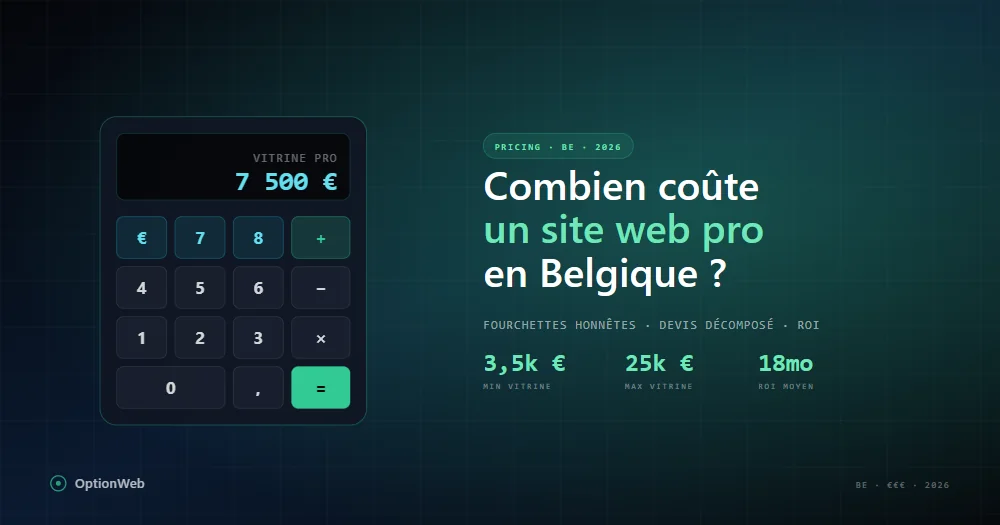
How much does a professional website cost in Belgium in 2026?
Pricing guide: honest ranges for brochure sites, e-commerce, SaaS, custom builds. Quote breakdown, hidden costs, freelancer vs agency, real ROI and transparent pricing grid.
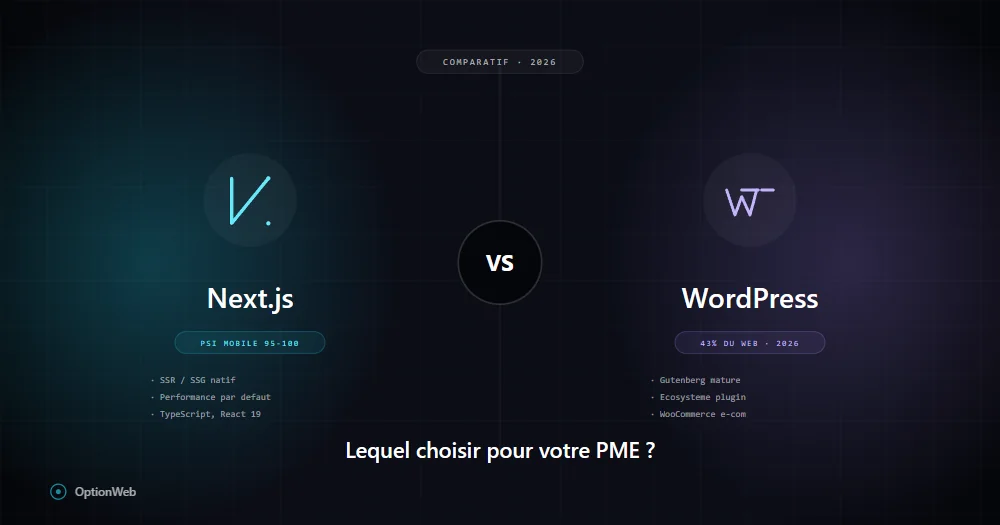
Next.js vs WordPress in 2026: which one for a Belgian SMB?
Honest Next.js vs WordPress comparison for SMBs: real costs, performance, SEO, maintenance, security, flexibility. When to choose one or the other based on your profile.