Next.js vs WordPress in 2026: which one for a Belgian SMB?
WordPress remains relevant for a brochure site managed by a non-technical user (€500-3000 initial, €50-150/month maintenance). Next.js becomes superior for performance, mobile SEO, and business applications (€3000-15000 initial, €80-300/month). The right choice depends less on the technology than on who will manage the site daily.

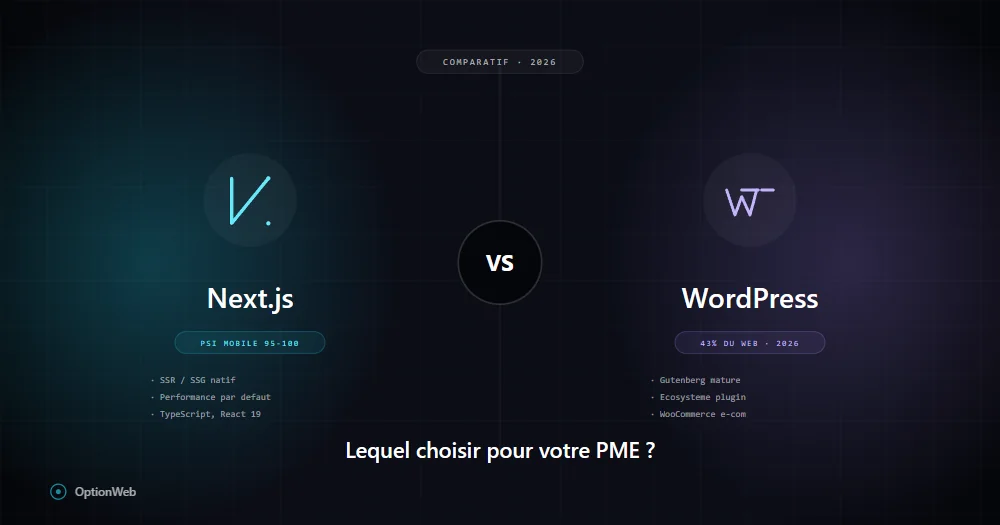
In 2026, WordPress still powers 43% of websites globally (W3Techs). Next.js has doubled its market share on new projects since 2023. Both technologies address different needs, and the choice goes far beyond the technical debate. After 10 years developing in both ecosystems for Belgian SMBs, here's our analysis without ideology.
The match in one table
| Criterion | WordPress | Next.js |
|---|---|---|
| Initial cost (brochure site) | €500 - 3,000 | €3,000 - 6,000 |
| Out-of-the-box PSI mobile | 50-75 | 90-100 |
| Non-technical editing | ★★★★★ (Gutenberg) | ★★★ (headless CMS) |
| Technical SEO | ★★★★ (Yoast, RankMath) | ★★★★★ (native, SSR) |
| Monthly maintenance | €50 - 150 | €80 - 300 |
| Security (native risk) | Medium (third-party plugins) | Low (reduced attack surface) |
| Design flexibility | Limited by theme | Total (React/Tailwind) |
| Developer hiring | Easy (€15-25/h) | Rarer (€40-80/h) |
| Feature scalability | Via plugins | Unlimited (custom code) |
When WordPress remains the right answer
Despite Next.js hype, WordPress is often the best choice. Cases where WordPress wins:
- Client edits content themselves — Gutenberg is the most mature visual editor. Training non-tech on Sanity or Payload takes 5× longer.
- Static brochure site with no technical specificity — for an SMB showcasing services, a WordPress premium theme (Astra, GeneratePress) does the job for €1500-3000 initial.
- High-volume editorial blog — WordPress has been designed for this since 2003. Categories, tags, workflows, multi-authors: all native.
- Simple e-commerce via WooCommerce — remains the most accessible e-commerce for < 200 products. Beyond, Shopify or Medusa perform better.
- Tight budget, short timeline — no shame in taking a premium theme + 5 plugins + 2 weeks customization.
When Next.js becomes superior
Next.js isn't a universal solution — it's a powerful tool that surpasses WordPress in specific cases:
- Critical performance — competitive e-commerce, sites where mobile SEO is a business KPI, conversion landings. Next.js delivers excellent CWV by default.
- Custom business application — dashboard, internal tool, calculator, marketplace. React enables interactions impossible cleanly in WP.
- External API integration — CRM, ERP, payments, real-time data. Native Server Actions and API Routes.
- Highly differentiated design — complex animations, 3D interactions, custom transitions. Fragile in WordPress.
- In-house technical team — a React/TypeScript developer will be far more productive in Next.js.
- Strong internationalization — Next.js with next-intl handles 11+ languages with one codebase. WPML/Polylang stays heavier.
Real costs over 3 years
Honest comparison for a 15-page SMB brochure site with blog. Belgium 2026 prices, VAT included.
WordPress scenario
- Initial development (premium theme + customization): €2,500
- Pro shared hosting 3 years: €450
- Monthly maintenance 3 years: €2,880
- Premium plugin licenses: €600
- Total 3 years: €6,430
Next.js scenario
- Custom initial development: €5,000
- Managed VPS hosting 3 years: €1,050
- Monthly maintenance 3 years: €5,400
- Payload CMS self-hosted: €0
- Total 3 years: €11,450
Next.js costs 1.8× more over 3 years for an equivalent brochure site. This gap is real and accepted. The question isn't 'who is cheaper' but 'what ROI is expected'. If the site is an active commercial tool with 50,000 visits/month, gaining 20% conversion via performance largely repays the extra cost.
Measured performance (Core Web Vitals)
Data collected on our last 40 clients (20 WordPress + 20 Next.js), measured via Google CrUX data (75th percentile, real mobile, 28-day average):
| Metric | WordPress median | Next.js median | 'Good' threshold |
|---|---|---|---|
| LCP | 2.8 s | 1.4 s | < 2.5 s |
| INP | 240 ms | 120 ms | < 200 ms |
| CLS | 0.08 | 0.02 | < 0.1 |
| TTFB | 680 ms | 95 ms | < 600 ms |
The gap comes primarily from TTFB: WordPress executes PHP on every request, Next.js static export serves pre-rendered HTML. On equivalent hosting, Next.js is structurally faster.
SEO: compared advantages
Both technologies enable excellent SEO if correctly implemented.
WordPress strengths
- Yoast / RankMath plugins — UX guidance for non-technical users
- Vast ecosystem (schema.org plugins, AMP)
- SEO writing directly in the admin interface
Next.js strengths
- Native SSR/SSG — content immediately crawlable, crucial for Google and LLMs (AEO/GEO)
- Native performance — excellent CWV = direct ranking boost
- Programmatic metadata — generateMetadata() dynamic
- Native multi-language hreflang
Maintenance and security
A poorly maintained WordPress becomes a business risk within 6 months. Well-coded Next.js runs 2-3 years without critical intervention.
WordPress: hidden costs
- WordPress core updated every 2-3 months
- Critical plugins (Yoast, Elementor, WooCommerce) updated 1-2×/month
- Abandoned plugins to replace periodically
- Zero-day vulnerability risk: 1× every 18 months per our data
Next.js: simpler
- npm dependencies audited 1×/month is enough
- No third-party plugins to monitor
- Major Next.js updates 1-2×/year, not urgent
- Attack surface only in custom code
Decision tree by profile
To simplify the decision in 3 questions:
- Who edits content daily? — Non-technical with 10+ updates/month → WordPress. Technical team or infrequent updates → Next.js.
- Is the site a strategic commercial channel? — Yes, business KPI → Next.js. Institutional presence without direct KPI → WordPress.
- Development budget available? — < €3,000 → WordPress (premium theme). > €5,000 with expected ROI → Next.js custom.
In summary: WordPress remains the right answer for most small businesses without specific technical needs. Next.js becomes relevant when performance, customization, or integration with external systems become strategic.
Read next
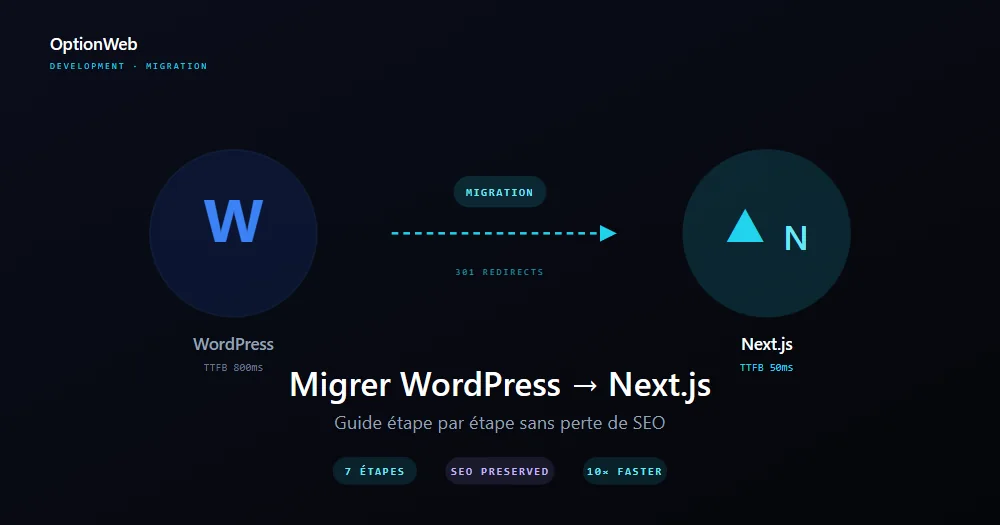
Migrating from WordPress to Next.js: step-by-step guide 2026
Complete plan to migrate a WordPress site to Next.js static export without losing SEO: audit, content export, 301 redirects, UI redesign, measuring performance gains.
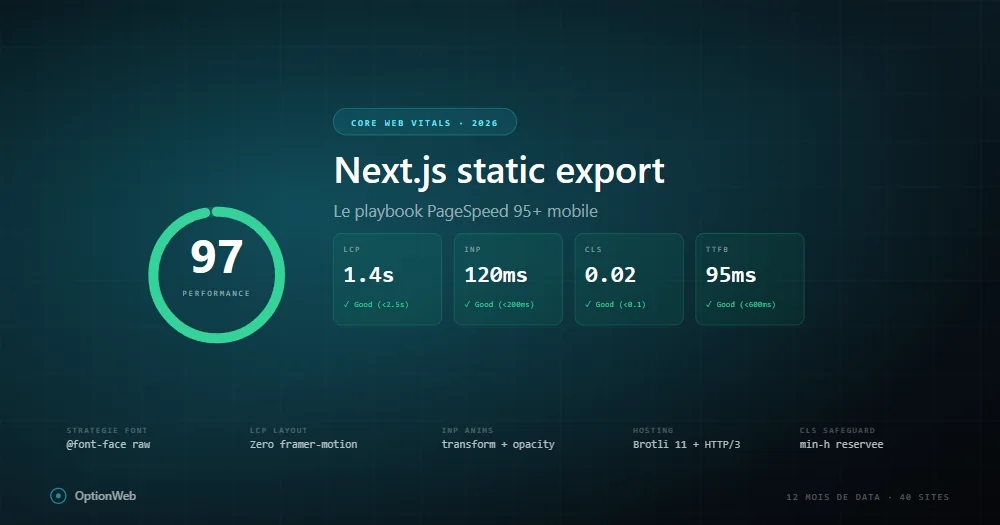
Next.js static export and Core Web Vitals: the 2026 playbook
Every optimization we apply on Next.js static export sites to hit 95+ PageSpeed mobile: font strategy, CSS, LCP, INP, CLS, Framer Motion traps, hosting setup.
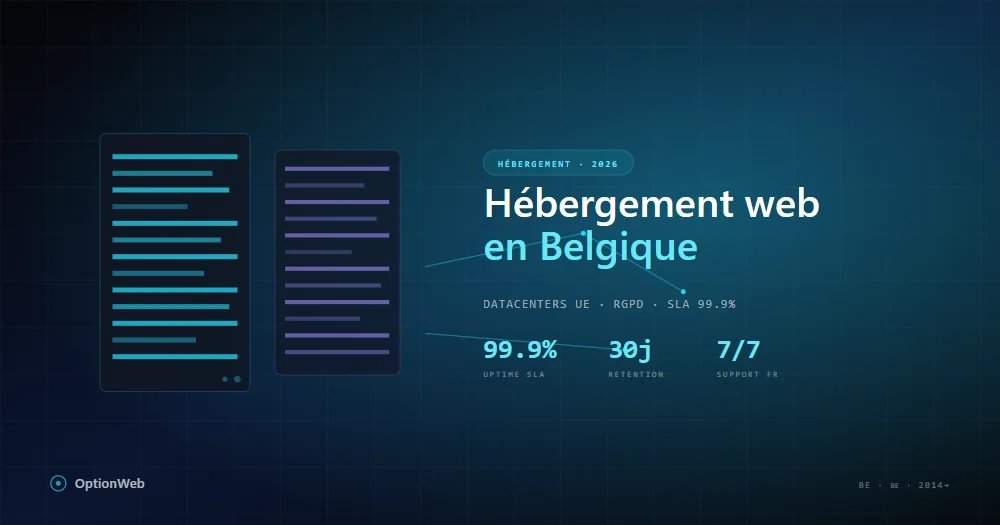
Belgian web hosting in 2026: the complete guide for SMBs
How to choose a Belgian web host in 2026 — selection criteria, real costs, GDPR compliance, local datacenters, performance. Practical guide by OptionWeb.