Building an E-commerce Website in Belgium: Cost, VAT, Payments
Expect €30 to €400/month for a SaaS store such as Shopify (plus a commission on every sale), and from a few thousand to several tens of thousands of euros for a custom-built e-commerce site. In Belgium, three requirements are non-negotiable: 21% VAT configured correctly, the 14-day right of withdrawal for B2C sales, and Bancontact at checkout — it dominates Belgian online purchases. Realistic time to launch: 6 to 12 weeks.

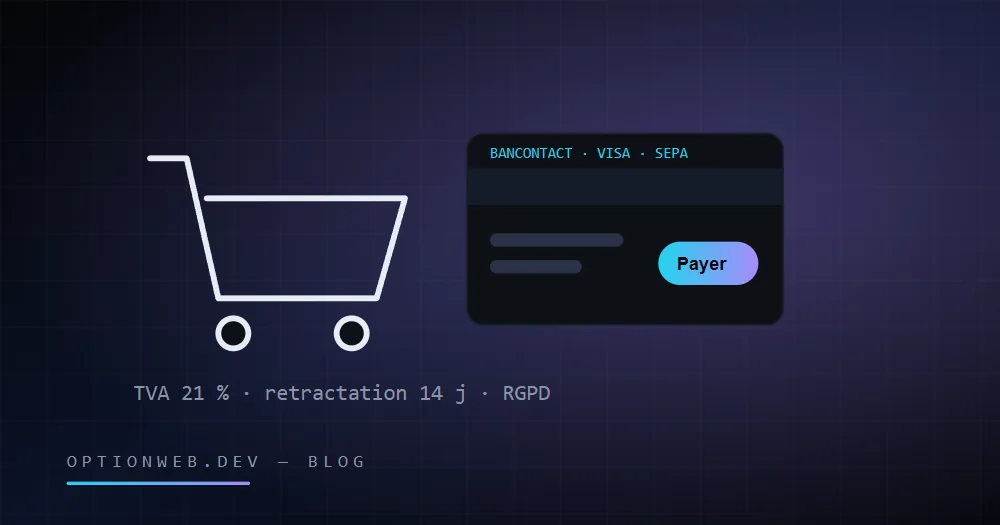
Building an e-commerce website in Belgium costs between €30 and €400/month for a SaaS solution such as Shopify (plus a commission on every sale), and from a few thousand to several tens of thousands of euros for a custom-built store. On top of that budget come three Belgian imperatives: 21% VAT, the 14-day right of withdrawal, and Bancontact at checkout.
This guide breaks down the real price ranges in 2026, the legal obligations that apply to every Belgian online merchant, the payment methods you should offer, and an honest comparison of Shopify, WooCommerce and custom development. The goal: letting you budget and launch your store without unpleasant surprises.
1. How much does an e-commerce website cost in Belgium in 2026?
The cost depends first and foremost on the approach you choose: a SaaS platform rented by the month, an open-source CMS installed on your own hosting, or custom development. Each option comes with very different entry and recurring costs — comparing the upfront price alone is the surest way to get it wrong.
| Approach | Initial cost | Recurring costs | Best for |
|---|---|---|---|
| SaaS (Shopify, Wix eCommerce) | €0 to €2,000 (theme, configuration, migration) | €30 to €400/month + per-transaction commissions | Fast launch, simple catalogue, zero technical management |
| WooCommerce / PrestaShop with a professional | €3,000 to €10,000 depending on catalogue and design | Hosting + maintenance (usually €50 to €250/month) | SMEs that want to own their store and control their costs |
| Custom build (Next.js, headless) | From a few thousand euros, quoted individually | Hosting + maintenance as per contract | Specific business logic, integrations, demanding performance |
At OptionWeb, a showcase website starts at €2,890 excl. VAT; e-commerce projects, which involve a catalogue, payments, VAT and logistics, are quoted individually after a needs analysis — with an answer within 48 hours. That is the honest market practice: an e-commerce site advertised at a fixed price before anyone has seen your catalogue almost always hides extra charges.
Beyond the build itself, budget for the side costs that most quotes never mention:
- Payment commissions — The payment provider takes a commission on every sale — usually between 1 and 3% depending on the payment method, plus a fixed fee of a few dozen cents per transaction.
- Hosting and domain name — €10 to €50/month for a properly hosted SME store, plus the domain (from €5/year at OptionWeb, 900+ extensions).
- Maintenance and security — Updates, backups, security patches, monitoring. Essential the moment you take money online. At OptionWeb: €79 to €399/month depending on the tier.
- Product photos and content — Chronically underestimated. Good photos and unique descriptions do more for your sales than any plugin ever will.
- Traffic acquisition — A store with no visitors sells nothing. Plan an SEO and/or advertising budget from day one (SEO/marketing from €299/month at OptionWeb).
2. What are the legal requirements for selling online in Belgium?
Selling online in Belgium falls under the Code of Economic Law and the GDPR. The rules are well known, enforced by the FPS Economy, and ignoring them costs you dearly: fines, customer disputes, and in the worst case sales contracts that cannot be enforced. Here is the non-negotiable baseline.
- Complete legal notice — Company name, registered office address, CBE company number, VAT number, direct contact details (email and phone). It must be reachable from every page.
- General terms and conditions of sale — VAT-inclusive prices, delivery charges, payment terms, delivery times, the two-year statutory conformity warranty for B2C sales. The customer must explicitly accept them before paying.
- 14-day right of withdrawal — Any consumer may return a purchase within 14 calendar days without giving a reason. You must inform them clearly and provide a withdrawal form.
- GDPR and cookies — Privacy policy, prior consent for non-essential cookies, a record of processing activities. An e-commerce site collects a lot of personal data: addresses, purchase histories, browsing behaviour.
- VAT applied correctly — Standard rate of 21%, reduced rate of 6% for certain goods (food in particular). Prices must be displayed inclusive of VAT for consumers.
On VAT, one point deserves your attention if you sell outside Belgium: since the EU e-commerce reform, sales to consumers in other EU countries above an annual threshold of €10,000 must be invoiced at the customer's country VAT rate, through the OSS one-stop shop. Your platform must be able to handle multiple rates; your accountant must be informed before the first cross-border sale, not after.
3. Which payment methods should you offer in Belgium?
Belgium has one particularity that American platforms superbly ignore: Bancontact. It is by far the preferred online payment method in Belgium, particularly via the Payconiq by Bancontact app on mobile. A Belgian store without Bancontact loses sales every single day, at the exact moment the customer has their card in hand.
| Payment method | Importance in Belgium | Indicative cost | Verdict |
|---|---|---|---|
| Bancontact / Payconiq | Dominant — the Belgian payment reflex | Low fixed fee per transaction | Essential |
| Visa / Mastercard cards | Strong, especially for higher amounts and foreign customers | Usually 1.5 to 3% per transaction | Essential |
| PayPal | Valued for buyer protection, especially in C2C and small baskets | Among the highest commissions | Recommended |
| Bank transfer | Useful in B2B and for large amounts | Nearly free, but deferred payment | Optional (B2B: yes) |
| Apple Pay / Google Pay | Growing on mobile, one-tap checkout | Aligned with card fees | Recommended |
In practice, you don't sign up with each payment method separately: you go through a payment service provider (PSP) that aggregates them. For a Belgian SME, Mollie is often the simplest choice — Dutch, native Bancontact support, no subscription, per-transaction billing. Stripe is the solid alternative if you have more technical needs (subscriptions, marketplaces). Both integrate with Shopify, WooCommerce and custom-built stores.
One detail that matters: the money you collect passes through the PSP's account before being paid out to your business account, usually within a few working days. Factor that delay into your launch cash flow, especially if your suppliers make you pay on order.
4. Shopify, WooCommerce or custom: which should you choose?
There is no best platform in absolute terms — there is the one that matches your catalogue, your in-house skills and your time horizon. Here is the honest comparison, including what each option is least proud of.
| Criterion | Shopify (SaaS) | WooCommerce (open source) | Custom build |
|---|---|---|---|
| Entry cost | Low (monthly subscription) | Medium (professional setup + configuration) | High (development quoted individually) |
| Cost over 3 years | High (subscription + apps + commissions add up) | Moderate (hosting + maintenance) | Variable, pays off if volume follows |
| Store ownership | No — you rent, and your data doesn't leave easily | Yes — code and data belong to you | Yes — fully |
| Technical maintenance | Included, handled by Shopify | Your responsibility (or a maintenance contract) | Contract with the agency |
| Customisation | Limited by the platform and its apps | Extensive via extensions and code | Unlimited |
| Bancontact and Belgian VAT | OK via PSP, VAT needs careful configuration | OK via PSP, battle-tested VAT plugins | Implemented exactly for your case |
| Performance / SEO | Decent, little room for optimisation | Good if well hosted and maintained | Excellent by design |
When Shopify is the right choice
You are testing a market, you sell simple products, you have no one in-house to handle the technical side, and you accept paying a growing rent as you add apps. Shopify excels at validating an idea within a few weeks. The trap: as the store grows, the monthly bill (plan + apps + commissions) grows with it, and migrating elsewhere becomes a real project.
When WooCommerce is the right choice
You want to own your store, keep recurring costs under control and benefit from a mature extension ecosystem (EU VAT, Belgian carriers such as bpost, invoicing). The trade-off is well known: WordPress and its plugins demand disciplined updates and a real security policy. Without a maintenance contract, a WooCommerce store left unattended becomes a target.
When a custom build becomes worth it
Product configurators, per-customer B2B pricing, synchronisation with an ERP or point-of-sale software, high-volume catalogues, performance requirements: as soon as the business logic leaves the standard path, bending a generic platform costs more than building it right. A custom front end (Next.js or equivalent) also delivers loading times no generic theme can match — and speed shows up directly in your conversion rate.
5. The stages of a successful e-commerce project
An e-commerce project that goes off the rails is almost always a project that skipped a step early on. Here is the proven sequence, from brief to first sale:
- Scope the project: catalogue (number of references, variants), delivery zones, B2C or B2B, required integrations (point of sale, accounting, stock). This scoping determines the budget, not the other way around.
- Sort out the legal and administrative groundwork: active CBE and VAT numbers, terms and conditions drafted, business bank account, registration with the payment provider (KYC verification takes several days, start it early).
- Choose the platform based on the scoping — not on fashion or the last ad you saw.
- Prepare the product content: photos, unique descriptions, VAT-inclusive prices, size charts or spec sheets. This is the longest workstream on the client side, so start it on day one.
- Build the store: design, product pages, checkout funnel, VAT and shipping configuration, PSP connected in test mode.
- Test the full journey: a real order with every payment method, confirmation email, compliant invoice, refund and withdrawal. A funnel that hasn't been tested end to end isn't finished.
- Go live with the SEO foundation in place: clean URL structure, product structured data, sitemap, Google Business Profile if you also have a physical shop.
- Measure and iterate: conversion tracking, abandoned carts, traffic sources. You steer a store by the numbers, not by gut feeling.
Realistic timeline for a standard SME store: 6 to 12 weeks from brief to launch. Projects that take 6 months are rarely blocked by the technology — they are waiting for photos, copy or a decision.
6. Which mistakes kill an online store's conversions?
Attracting a visitor is expensive; losing them at checkout costs double. These mistakes show up in the majority of Belgian stores we audit — and every one of them can be fixed.
- Delivery charges revealed at the last step — The number one cause of cart abandonment. Display the charges (or the free-delivery threshold) right on the product page.
- No Bancontact — A Belgian customer who can't find their usual payment method doesn't reach for a credit card: they close the tab.
- Mandatory account creation — Always offer guest checkout. Suggest the account after the purchase, not before.
- A slow site, especially on mobile — Every second of loading time is paid for in lost visitors. Most e-commerce traffic is mobile: test on a phone first.
- Photos and descriptions copied from the supplier — You look like 50 competitors, Google demotes duplicate content, and nothing reassures the customer about what they will actually receive.
- No visible reassurance — 14-day returns, statutory warranty, customer reviews, a human contact: these elements must be visible in the funnel, not buried in the terms and conditions.
- Abandoned carts never followed up — A reminder email (GDPR-compliant, with consent) recovers a meaningful share of lost sales. Most stores never switch it on.
Where should you start your e-commerce project?
Let's recap. Budget: from a few hundred euros a year for a fully self-managed SaaS store to several thousand euros for a professional build, with a first-year total generally between €5,000 and €15,000 for a serious SME. Legal: legal notice, terms and conditions, 14-day withdrawal, GDPR and 21% VAT configured correctly. Payment: Bancontact first, cards next, all through a PSP such as Mollie. Platform: SaaS to test fast, WooCommerce to own your store, custom when the business logic demands it.
The right first step isn't choosing a tool — it's scoping your project: catalogue, logistics, integrations, real budget. That is exactly what we do at OptionWeb before quoting anything — needs analysis, a reasoned platform recommendation, and a detailed e-commerce quote within 48 hours. If you want a concrete opinion on your online store project, request a free quote: worst case, you'll walk away with a clearer scope than when you arrived.
Read next
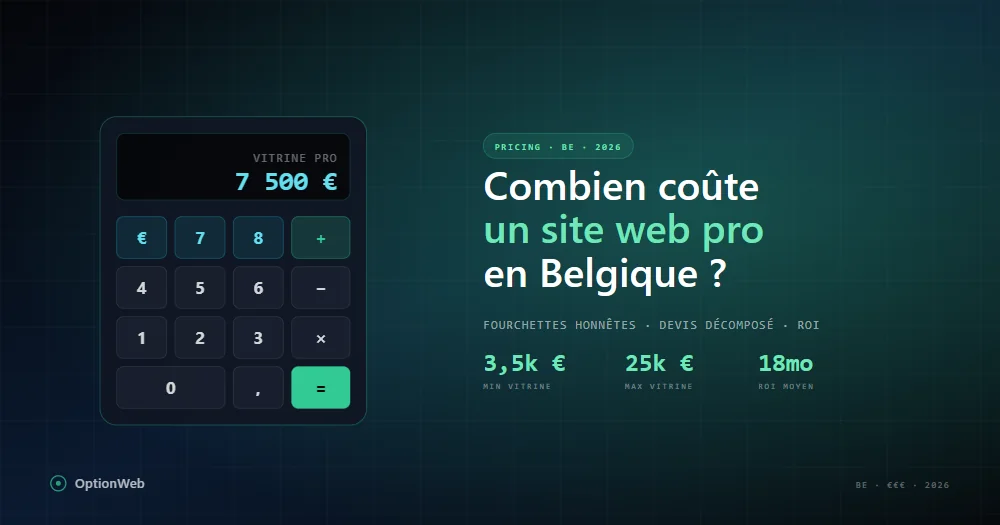
How much does a professional website cost in Belgium in 2026?
Pricing guide: honest ranges for brochure sites, e-commerce, SaaS, custom builds. Quote breakdown, hidden costs, freelancer vs agency, real ROI and transparent pricing grid.

GDPR and your website in 2026: compliance guide for European SMEs
Cookies, Consent Mode v2, non-EU transfers, DPO, processing register, retention periods: everything an SME must configure in 2026 to stay GDPR compliant.
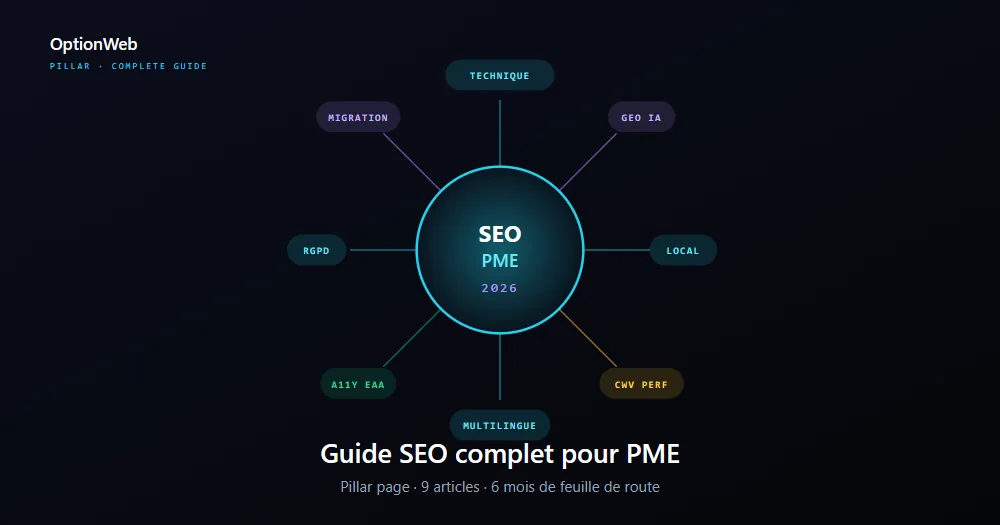
Complete SEO guide for SMBs in 2026: OptionWeb pillar page
Full map of SEO 2026 for SMBs: technical, GEO, local, multilingual, performance, accessibility, GDPR. Hub linking to the 9 deep-dive blog articles.