How to Choose a Web Agency in Belgium: 12 Criteria for 2026
To choose a web agency in Belgium, check 12 criteria: a verifiable online portfolio, full ownership of the code, modern technologies, European hosting, SEO included, a clear maintenance contract, a Belgian VAT number, genuine client reviews, written deadlines, a documented process, multilingual support and financial stability. Avoid 36-48 month commitments, templates sold as custom work and locked code. A custom brochure site costs €1,500 to €25,000 depending on the provider.

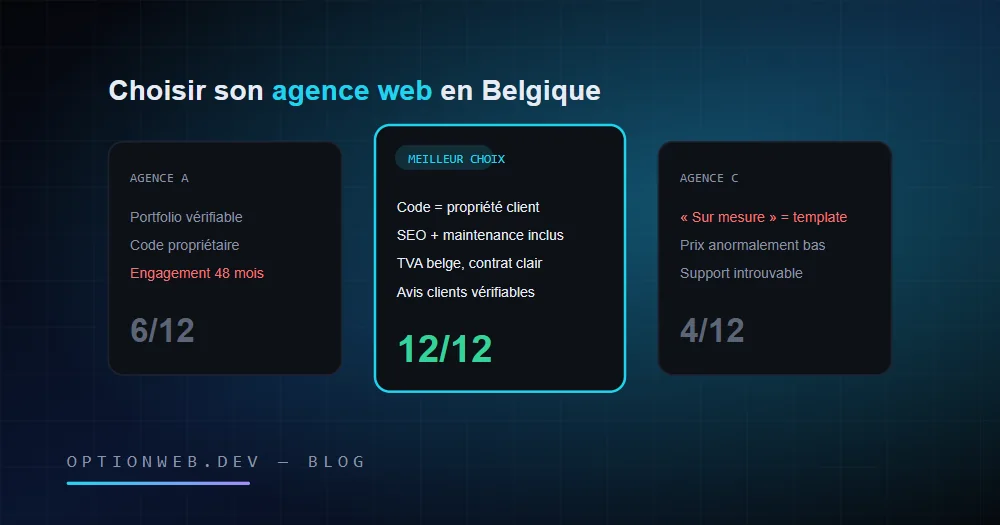
Choosing a web agency in Belgium comes down to 12 verifiable criteria: a portfolio you can browse online, full ownership of the delivered code, modern technologies, GDPR-compliant European hosting, a clear SEO offering, a transparent maintenance contract, a Belgian VAT number, genuine client reviews, written deadlines, a documented process, multilingual support and a stable, established business. This guide breaks down each criterion, lists the red flags, gives you the exact questions to ask in meetings and a scoring grid to rank your shortlist.
The market is vast: DNS Belgium counts more than 1.7 million active .be domain names, and hundreds of agencies, web consultants and freelancers compete for SME projects. Let's be upfront: OptionWeb is a Belgian web agency, so yes, we have skin in this game. But the checklist below is exactly the one we would hand to a friend comparing three quotes — even if none of the three came from us.
1. What are the 12 criteria for choosing a web agency?
The 12 criteria fall into three groups: proof through work (portfolio, code, technologies, hosting), the contract and the money (SEO, maintenance, VAT, deadlines) and the relationship (reviews, process, languages, longevity). A good provider ticks at least 10 of the 12 boxes. Two criteria are deal-breakers regardless of everything else: code ownership and contractual transparency.
Criteria 1 to 4: proof through work
- 1. A verifiable online portfolio — Insist on URLs of live sites, not screenshots. Visit each one: loading speed, mobile rendering, spelling mistakes. A portfolio without clickable links often hides abandoned projects or purchased templates.
- 2. Ownership of the code and access — The source code, domain name, hosting and Google Search Console must be in your name or transferable free of charge. A website you own nothing of is a rental in disguise, not a business asset.
- 3. Modern, documented technologies — Ask for the exact stack: WordPress, Next.js, Shopify, a proprietary CMS? A widely used technology guarantees another developer can take over the project. A closed in-house CMS chains you to the provider for life.
- 4. Transparent, European hosting — Where will the site be hosted, at what monthly price, with what contractual uptime? Hosting in Europe is essential for GDPR compliance. Beware of "hosting included" offers with no details: it is often oversold shared hosting resold at a markup.
Criteria 5 to 8: the contract and the money
- 5. SEO included or optional — but explicit — A site without SEO fundamentals (meta tags, sitemap, performance, structured data) is invisible on Google. Ask what is included in the base price and what falls under a separate monthly plan. Vagueness on this point produces beautiful sites nobody can find.
- 6. A readable maintenance contract — Updates, backups, security patches, response times: everything must be in writing, with a monthly price and a reasonable commitment period. Our guide to website maintenance costs details the normal market ranges.
- 7. Belgian registration and VAT number — A CBE company number and Belgian VAT mean compliant invoicing, deductible VAT and straightforward legal recourse in the event of a dispute. Check the number on the Crossroads Bank for Enterprises website: it is free and instant.
- 8. Written deadlines with milestones — A custom brochure site is delivered in 3 to 6 weeks, an e-commerce site in 6 to 10 weeks. Insist on a schedule with dates: mockups, development, acceptance testing, go-live. "As soon as possible" is not a deadline.
Criteria 9 to 12: the relationship
- 9. Verifiable client reviews — Cross-check Google reviews against the portfolio: do the companies mentioned exist? Do they really have the site shown? Three detailed, dated reviews are worth more than fifty reviews posted within a single week — a classic sign of purchased reviews.
- 10. A documented process — A serious agency describes its workflow without hesitation: brief, mockup, sign-off, development, testing, training, go-live. If the salesperson improvises the answer, the project will be improvised too.
- 11. Multilingual support — In Belgium, an FR/NL site — often with EN or DE as well — is frequently a commercial prerequisite. Check that the agency handles language versions properly (hreflang, dedicated URLs), not through an automatic translation widget.
- 12. A provider built to last — How long has the agency existed? Does it publish its accounts? A business founded ten years ago with loyal clients carries less risk than an agency created last year with a website full of stock photos.
These 12 criteria form the backbone of the scoring grid presented in section 5. Before we get there, let's set the price context: you cannot judge a quote without knowing the real ranges of the Belgian market.
2. How much does a web agency cost in Belgium in 2026?
In Belgium in 2026, a custom brochure site costs between €1,500 and €4,000 with a freelancer, between €3,000 and €8,000 at a small agency and between €10,000 and €25,000 at a large agency. The gap is explained by cost structures (overheads, team size, project management), not solely by the quality delivered. The table below sums up the typical ranges observed on the Belgian market, excluding VAT.
| Type of provider | Brochure site (excl. VAT) | E-commerce (excl. VAT) | Daily rate | Strength | Weakness |
|---|---|---|---|---|---|
| Freelancer / web consultant | €1,500 – €4,000 | €4,000 – €10,000 | €350 – €550 | Price, direct contact | Depends on a single person |
| Small agency (2-10 people) | €3,000 – €8,000 | €8,000 – €25,000 | €500 – €750 | Balance of price and continuity | Limited capacity at peak times |
| Large agency (20+ people) | €10,000 – €25,000 | €25,000 – €100,000+ | €800 – €1,200 | Specialised teams | Price, overhead, staff turnover |
These ranges apply to genuinely custom work. A template customised in a few hours structurally costs less — which is not a problem, as long as it is sold as such. For a line-by-line breakdown (design, development, content, hosting, maintenance), see our complete guide to website prices in Belgium in 2026, which dissects every item on a quote.
As a benchmark, OptionWeb delivers a 100% custom brochure site from €2,890 excl. VAT in 3 to 6 weeks, with the code handed over in full ownership and a quote within 24 hours. That positioning sits at the low end of the "small agency" range — precisely because our static stack (Next.js) cuts hosting and maintenance costs.
3. What red flags should make you walk away?
Four signals justify ruling out a web agency immediately: an abnormally low price (a "free" website in exchange for a subscription), a template sold as custom work, a 36- or 48-month contractual commitment and locked proprietary code. Each of these signals turns your website into a source of dependency rather than an asset.
- The "free" or €500 website — Nobody works at a loss. Behind a near-free website hides an inflated monthly subscription spread over several years: €79/month for 48 months adds up to €3,792 for a template you will never own.
- The template dressed up as custom work — A theme bought for €60 and lightly recoloured, billed at custom prices. Simple test: ask whether the design starts from a blank page and insist on seeing the intermediate mockups. Real custom work leaves traces (wireframes, iterations).
- The 36- or 48-month commitment — A maintenance contract should run for 12 months at most, renewable. A 4-year commitment, often backed by a leasing company, binds you even if the agency disappears or delivers mediocre work. It is the most expensive red flag on the Belgian market.
- Locked code or a closed proprietary CMS — If you can neither retrieve the code, nor export the content, nor transfer the domain, you are not buying a website: you are renting a storefront. The day you leave, you start from scratch.
- The guaranteed number-one position on Google — Google explicitly states that no SEO provider can guarantee a ranking. An agency that promises the number-one spot is lying about the most verifiable point of its own trade — imagine the rest.
- No identifiable legal entity — No CBE number on the website, no physical address, no legal notice: no recourse whatsoever in the event of a dispute. In 2026, a web agency without a compliant legal notice is disqualified outright.
One isolated red flag deserves a question; two red flags deserve a refusal. The cost of a bad choice goes beyond the quote: according to Google, 53% of mobile visitors leave a page that takes more than 3 seconds to load. A poorly built site loses you customers every day, in silence.
4. What questions should you ask at the first meeting?
Ten questions are enough to assess a web agency in a one-hour meeting. They cover ownership, technology, deadlines, SEO and post-delivery support. Ask them in this order and write down the answers: you will need them for the scoring grid in the next section.
- "Will the source code, the domain name and the hosting be in my name? Can I move my site to another provider free of charge?"
- "What technology do you use and why? Could another developer take over the project?"
- "Can you show me three sites delivered in 2025-2026, with the client's name, so I can contact them?"
- "What does the price include for SEO? Meta tags, performance, structured data, sitemap?"
- "Where will the site be hosted, at what monthly price, with what uptime commitment?"
- "What is the exact schedule, with dates for mockups, acceptance testing and go-live?"
- "What does maintenance cover, at what price, and what is the minimum commitment period?"
- "What happens if I cancel? Is there a written exit clause?"
- "Who will be my point of contact during the project and after delivery?"
- "What PageSpeed score do your last three projects achieve on mobile?"
Interpret the answers simply: a good agency replies quickly, in writing, with numbers. An agency that is evasive on question 1 (ownership) or question 8 (exit clause) is eliminated, whatever the quality of its portfolio. Question 10 is an excellent litmus test: an agency that does not know the scores of its own deliverables is not measuring what it produces.
5. How do you compare several agencies objectively?
The most reliable method is to score each agency from 0 to 5 on the 12 criteria, weight each score by the importance of the criterion, then compare the totals. This grid removes the "charming salesperson" effect: a friendly agency that stays vague about code ownership automatically drops down the ranking.
Reproduce the table below in a spreadsheet, with one column per shortlisted agency. Score 0 (absent or refused), 3 (adequate) or 5 (excellent and proven) for each criterion, then multiply by the weight. The maximum score is 125 points.
| Criterion | Weight | How to score (0 / 3 / 5) |
|---|---|---|
| Verifiable portfolio | ×3 | 0: screenshots only · 3: clickable links · 5: clients you can contact |
| Ownership of code and access | ×3 | 0: locked code · 3: partial ownership · 5: full ownership written into the contract |
| Technologies | ×2 | 0: closed proprietary CMS · 3: widely used stack · 5: modern, well-justified stack |
| Hosting | ×2 | 0: no details · 3: named host · 5: Europe, contractual price and uptime |
| SEO | ×3 | 0: not addressed · 3: basics included · 5: written scope, examples of results |
| Maintenance | ×2 | 0: completely vague · 3: plan described · 5: SLA, price and term in black and white |
| Belgian VAT and legal entity | ×2 | 0: not found in the CBE · 3: identifiable EU entity · 5: CBE verified, complete legal notices |
| Deadlines | ×2 | 0: no dates · 3: overall timeframe · 5: schedule with dated milestones |
| Client reviews | ×2 | 0: none or suspicious · 3: genuine Google reviews · 5: reviews cross-checked against the portfolio |
| Process | ×2 | 0: improvised · 3: steps described · 5: documented process provided in writing |
| Multilingual | ×1 | 0: auto-translation widget · 3: FR/NL possible · 5: hreflang and dedicated URLs mastered |
| Longevity | ×1 | 0: entity < 1 year old, opaque · 3: 3+ years in business · 5: 5+ years, loyal clients, published accounts |
Reading the results: above 100 points, sign with confidence. Between 75 and 100, negotiate the weak points before signing. Below 75 points, look elsewhere. And if two agencies score above 100, decide between them on the criterion that matters most to you — for an SME that lives on local customers, that is almost always SEO.
6. Should you choose a Belgian agency or a foreign provider?
A Belgian agency offers three concrete advantages: invoicing with deductible Belgian VAT, a shared legal framework in the event of a dispute and native knowledge of the local market (FR/NL bilingualism, payment habits, regulations). An offshore provider costs 30 to 60% less per hour, but that saving often evaporates in back-and-forth, misunderstandings and code rework.
- VAT and accounting — With a Belgian agency, the 21% VAT is deductible in the usual way. With a provider outside the EU, you handle reverse-charge VAT yourself and lose any simple recourse if an invoice is disputed.
- GDPR and hosting — A European agency hosts your data in Europe by default. According to Statbel, more than 8 out of 10 Belgian companies with at least 10 employees have a website: GDPR compliance is no longer a luxury, it is the standard your own customers expect.
- Market and languages — A website for the Belgian market must handle FR and NL properly — see our guide to multilingual SEO and hreflang. A local agency knows this terrain; a distant provider discovers it at your expense.
- Real cost — The offshore hourly rate is unbeatable on paper. But a poorly scoped project at €30/hour that takes three times as many iterations ends up costing more than a well-scoped project at €90/hour — not counting your own coordination time.
The rational choice depends on the project. For a brochure or e-commerce site aimed at the Belgian market, the local or national provider almost always wins on total cost of ownership. Offshore still makes sense for highly specific development managed by an in-house technical team — a rare situation in an SME.
7. How do you verify an agency's reliability before signing?
Five free checks, doable in 30 minutes, are enough to confirm or overturn your final choice: the CBE number, cross-checked Google reviews, the portfolio's real-world performance, the age of the domain name and a call to an existing client. No serious agency will refuse that last one.
- Check the company number on kbopub.economie.fgov.be (Crossroads Bank for Enterprises): creation date, declared activity, active status.
- Cross-check Google reviews against the portfolio: look up the companies mentioned and verify that their site matches the one shown.
- Run three recent projects through PageSpeed Insights and check the mobile score — according to HTTP Archive, the median web page weighs more than 2.5 MB, and sites delivered by a good agency do markedly better than the median.
- Check the age of the agency's own domain (whois): a domain registered 6 months ago behind a "15 years of experience" pitch deserves an explanation.
- Ask for the contact details of a client whose site was delivered more than a year ago and ask them three questions: were the deadlines met, does support respond, would you hire them again?
This due diligence takes half an hour and can save you thousands of euros. The stakes go beyond the website itself: according to BeCommerce, Belgian consumers spent more than €16 billion online in 2024. Your website is the entry point for that demand — handing it to the wrong provider is like closing your shop at rush hour.
One last reliable signal: the agency's ability to document results, not just deliveries. A redesign should be measured in traffic, speed and conversions. Our client case study detailing a migration from Wix to Next.js shows the kind of quantified outcome a serious agency should be able to produce for its own projects.
In short: choosing a web agency in Belgium means checking 12 criteria, avoiding 4 red flags, asking 10 questions and scoring the answers dispassionately in a grid. The whole method takes two hours. That is very little compared with an investment of several thousand euros and a tool that will carry your visibility for five years or more.
OptionWeb, a web agency founded in 2014 in Châtelet by Julien Daniel, is happy to be put through this very grid: code delivered in full ownership, a documented Next.js stack, European hosting from €9.99/month with 99.9% uptime, a quote within 24 hours and in-person meetings available in Charleroi, Namur, Liège, Mons or Brussels. Ask us the 10 questions from this guide — we actually recommend it: contact@optionweb.dev or +32 491 14 01 01.
Read next
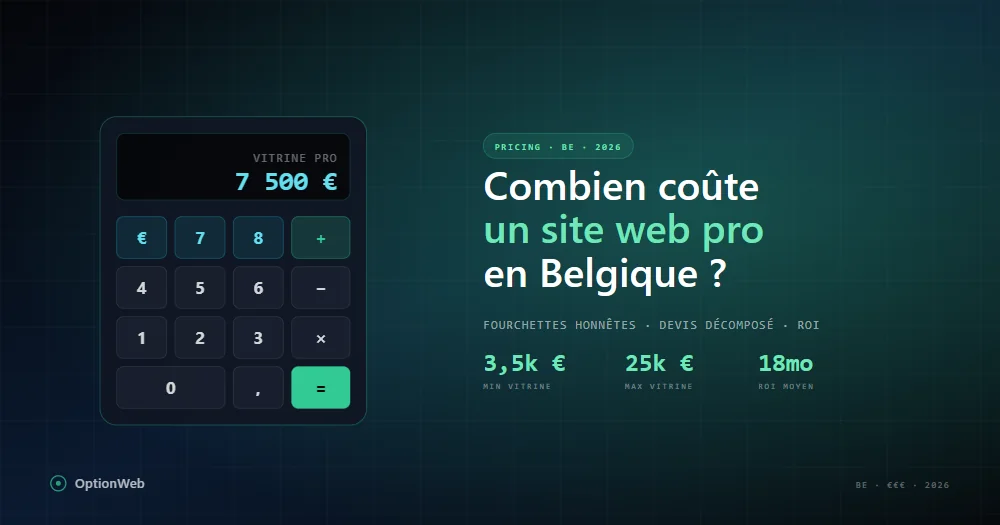
How much does a professional website cost in Belgium in 2026?
Pricing guide: honest ranges for brochure sites, e-commerce, SaaS, custom builds. Quote breakdown, hidden costs, freelancer vs agency, real ROI and transparent pricing grid.
Website Maintenance Cost in 2026 (Belgium Pricing)
How much does website maintenance cost in Belgium in 2026? Expect €50 to €400/month depending on complexity. Detailed plans, agency vs freelancer compared.
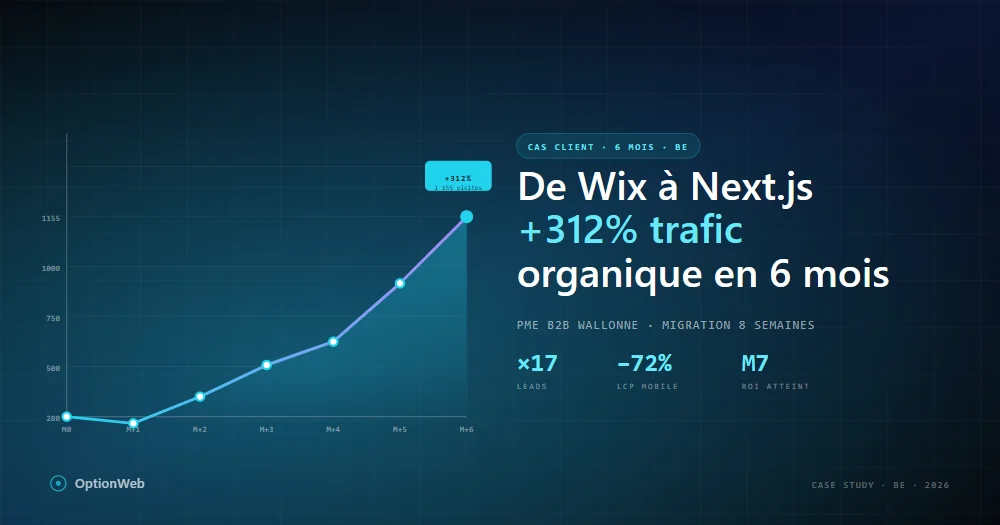
Case study: from Wix to Next.js, +312% organic traffic in 6 months
Full case study of a Belgian B2B SMB migrated from Wix to static Next.js: perf/SEO diagnosis, 6-phase migration plan, tech stack, month-by-month GSC results and concrete lessons.