Position Zero on Google: Get a Featured Snippet (2026)
The featured snippet, or position zero, is the answer box Google displays above the results. No markup triggers it: you must already rank in the top 10, answer the question in 40 to 60 words under a question heading and choose the right format (paragraph, list or table). This guide covers the method, the mistakes to avoid and how to measure results in 2026, now that AI Overviews are part of the picture.

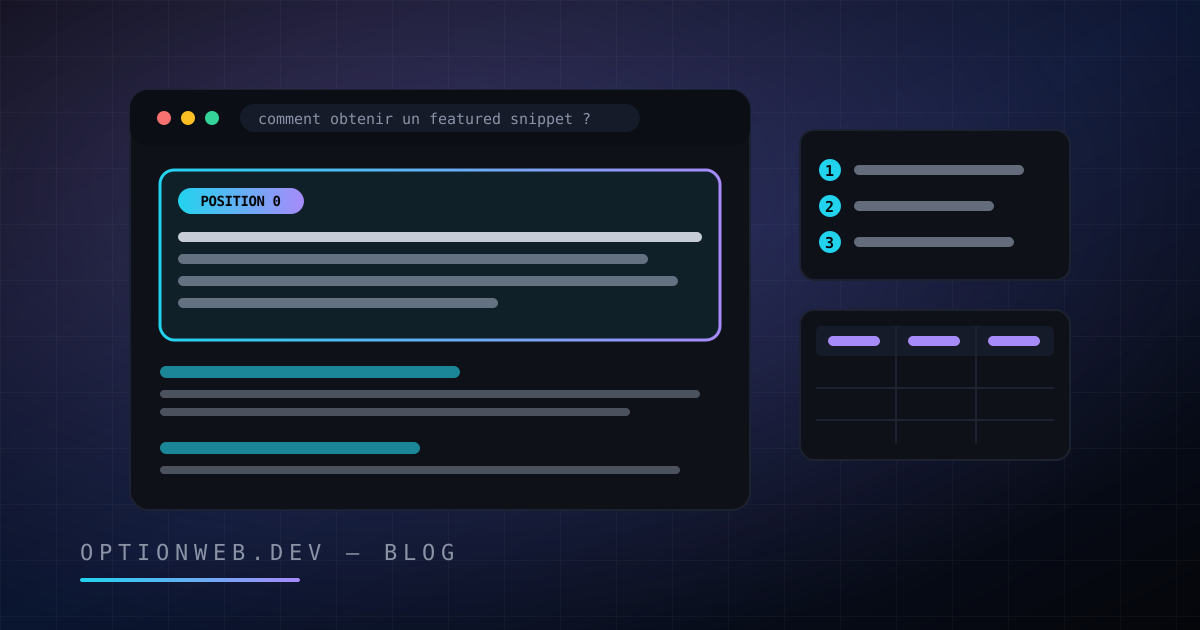
To win a featured snippet (Google's "position zero"), a page must already rank in the top 10 for the query, answer the question with a self-contained paragraph, list or table placed under a heading phrased like the question, and then do better than the answer currently displayed. No markup lets you request one: Google decides alone.
This guide is for Belgian SME managers, self-employed professionals and marketing managers who already have a decent website and want more visibility without producing ten times more content. You will find the formats that get picked up, a method to spot winnable queries, a writing recipe with an example, the place of People Also Ask, the mistakes that lose you a snippet and what to measure in 2026, when AI Overviews capture part of the clicks.
We apply this method ourselves on the OptionWeb blog: look at the summary at the top of the page, the direct 40 to 60-word answer under each question and the closing FAQ. For the overall framework, start with our complete SEO guide for SMEs.
1. What is position zero and is it still worth anything in 2026?
Position zero is the common name for the featured snippet: a box placed above the regular results that displays an extract from a page answering the question directly. Google states that it can also appear in the group of related questions, "People Also Ask", and that only its systems decide whether a page deserves to be highlighted (Google documentation).
Its value is more nuanced than ten years ago. An older Ahrefs study (2017, 2 million snippets, US database) measured 8.6% of clicks for the page cited in position zero, 19.6% for the result placed just below and 26% for a first result without a snippet (Ahrefs study). The snippet mostly brings visibility and brand credibility; it does not guarantee a surge of visits.
Since then, AI-generated answers have added a layer. Ahrefs finds, across 300,000 keywords, that the presence of an AI Overview comes with an average click-through rate 58% lower for the top-ranked page (December 2025 compared with December 2023, Ahrefs study published in February 2026). This is a correlation, not proof of cause. Practical conclusion: aiming for position zero is still worthwhile, provided you measure its real effect on your own site instead of assuming it.
2. Which formats does Google pick up: paragraph, list or table?
Google picks up extracts in three main forms: a paragraph for definitions, a list (numbered or bulleted) for steps and enumerations, and a table for comparisons. The format to publish is the one Google already displays for the query; do not change it, improve it.
| Snippet format | Typical queries | What to publish | Length guide |
|---|---|---|---|
| Paragraph | "what is", "why", "definition" | A self-contained definition, placed right under the question heading | 40 to 60 words |
| Numbered list | "how to", "steps to" | A real <ol> list, each step starting with a verb, short steps | 5 to 8 steps |
| Bulleted list | "types of", "criteria", "best" | A real <ul> list, one point per item | 4 to 8 bullets |
| Table | comparisons, prices, "X or Y" | A real HTML table with a header row | 3 to 6 rows |
The lengths in the last column are editorial guidelines from the trade, not rules published by Google. Their value is practical: a short, complete answer is easier to quote than a rambling paragraph.
3. How do you spot the queries you can win?
The right targets are question-type queries for which your page already ranks in the top 10 without occupying the box. This is a starting condition: in the 2017 Ahrefs study, 99.58% of the pages displayed as a snippet already ranked in the top ten results. There is no point writing for a query where you are not visible at all.
- Export your queries from Search Console (Performance, Queries tab) and keep those containing "how", "why", "what is", "how much", "which" or "difference".
- Filter by position: keep those where you rank between 2nd and 10th place, with a sufficient volume of impressions.
- Test each query in a private window, from Belgium and in the right language: is there a snippet, in what format, and which questions appear in "People Also Ask"?
- Note the format held by the competitor (paragraph, list or table) and keep it.
- Rewrite the answer under a heading phrased like the query, in 40 to 60 words, then add value afterwards (an example, a sourced figure, an edge case).
- Wait for reindexing, then retest after two to four weeks and compare positions and clicks in Search Console.
For proximity searches ("restaurant open near me"), the stakes are elsewhere: it is the local listing that counts, detailed in our guide to local SEO and Google Business Profile.
4. How do you write an answer Google can extract?
An extractable answer is a self-contained block placed immediately under a question heading: the first sentence answers, the following ones add detail, and the passage can be understood without reading the rest of the page. Both the reader and the search engine get the answer before the development, not after.
The question, answer, development structure
The heading echoes the wording of the query, the 40 to 60-word answer follows at once, then the development provides evidence, examples and nuance. Each section covers a single topic and names its entities explicitly (no "it" or "this" without an antecedent), because a passage is sometimes read in isolation.
A before-and-after example
Take the query "what is schema markup?". The two versions below say the same thing, but only one lends itself to extraction.
| Version | Text | Why |
|---|---|---|
| Before | "In an ever-changing digital world, more and more players are asking how best to make themselves understood by search engines, and this is where schema markup comes into play…" | The answer never arrives, the definition is buried in the introduction |
| After | "Schema markup is a vocabulary of structured data (schema.org) added to a page's code to describe its content explicitly to search engines: price, reviews, address, author. It helps Google understand the page, but does not guarantee a rich result or a featured snippet." | 43 words, subject named, definition then an honest limit |
The details of the useful schemas are in our schema markup guide.
Lists and tables: real HTML elements
For a list, use real <ol> or <ul> tags, one element per step, with no nested paragraphs. For a table, use a real <table> with a header row, never an image or styled blocks imitating columns. What the crawler does not read as a list or a table, it cannot pick up as one.
5. How do you appear in "People Also Ask"?
To appear in related questions, treat each frequent question as a section in its own right: a heading phrased as the question, a direct answer of 40 to 80 words, then a development. Google states that featured snippets can also be displayed in this group, which makes it a second entry point.
- Collect the questions by typing your query in a private window and expanding the suggested questions: each one reveals new ones.
- Group them by intent and cover the closest ones in the same article, each under its own heading.
- Add a visible FAQ at the end of the page with the remaining questions, 40 to 80 words each.
- Keep one page per topic: two articles answering the same question compete with each other.
The FAQ serves the reader and AI assistants first. Do not count on the enhanced display with stars or accordions, explained below.
6. Does FAQ and HowTo markup still work?
For most sites, no: since August 2023, Google only shows FAQ rich results for well-known, authoritative government and health sites, and it has removed HowTo rich results, whose desktop display stopped on 13 September 2023 (Google announcement). This is not a ranking change.
Google states that there is no need to remove this markup if it is already in place: unused markup causes no problem, it simply has no visible effect. Two practical rules follow:
- Do not invest in FAQ or HowTo markup hoping for an enhanced display.
- Keep the content (questions and steps visible on the page): it is what gets picked up, with or without markup, and it must match exactly what the reader sees.
For the schemas that remain useful (organisation, article, product, local business), see our schema markup guide.
7. Position zero, AI Overviews and clicks: what to measure in 2026?
In 2026, measuring position zero means tracking four signals: position and click-through rate per query, visibility in generative AI features, a manual test of the results page and the traffic actually received. Google states that there is no special optimisation or dedicated markup to appear in AI Overviews or AI Mode: the page must be indexed and eligible to be shown with a snippet (Google documentation).
A context to keep in mind: close to 60% of Google searches in Europe end without a click to a website (SparkToro and Datos study, 2024). Being the cited source therefore matters as much as the click.
| Indicator | Where to read it | What it tells you |
|---|---|---|
| Average position and click-through rate per query | Search Console, Performance report | A low click-through rate in position 1 or 2 may signal that a box is capturing the click |
| Impressions in generative AI | Search Console, Generative AI reports | Your pages shown in AI Overviews and AI Mode, by country and by device |
| Manual test of the query | Private window, Google in Belgium | Who holds the snippet, in what format, which related questions |
| Traffic from AI assistants | Your analytics tool, traffic sources | The visits actually sent by answer engines |
On 3 June 2026 Google launched "Search Generative AI" reports in Search Console, rolled out to all sites worldwide by 31 August 2026: impressions, pages, countries, devices and dates (Google announcement). This data remains included in the overall performance report. For citation by ChatGPT or Perplexity, see our GEO guide.
8. Which mistakes lose a featured snippet?
The most frequent mistakes are editorial (buried answer, wrong format) or technical (an extract blocked without you knowing). All of them can be fixed without rebuilding the site.
- The answer arrives after three paragraphs of introduction: place it right under the heading.
- The format does not match the intent: a paragraph for a steps question, a list for a definition.
- The content copies the competitor without adding anything: add an example, a sourced figure, an edge case.
- Two pages target the same question: merge them or differentiate the angle.
- The markup does not match the page: everything marked up must be visible and accurate.
- The extract is restricted unintentionally: a
nosnippetrule, adata-nosnippetattribute or a very lowmax-snippetvalue reduces the chances of being picked up. Google states that the shorter themax-snippetvalue, the less chance the page has of appearing as a featured snippet. - Key content is not in the rendered HTML: check with the URL Inspection tool in Search Console, covered in our technical SEO guide.
Check your robots tags in particular: an instruction set for another reason can block the extract across a whole page template.
9. What 30-day action plan for a Belgian SME?
A realistic plan fits into four weeks: audit twenty queries, rewrite five pages, add lists and tables, then measure. The aim is not to go for ten snippets at once but to win one or two and understand why.
- Week 1, audit: export the question-type queries, test them in a private window, note the formats held by your competitors.
- Week 2, rewrite: take five pages ranking between 2nd and 10th place, with a question heading and a 40 to 60-word answer.
- Week 3, formats: add numbered lists and HTML tables where the intent calls for them, and a visible FAQ.
- Week 4, measurement: compare positions, clicks and impressions, check the Generative AI reports, retest the queries by hand.
Only then extend the method. And do not forget what happens after the click: a page that answers but does not convince earns nothing, hence the value of our guide to the landing page that converts. To budget for support, see the cost of SEO in Belgium.
To discover the full offer, see our SEO and marketing page or write to us.
Read next
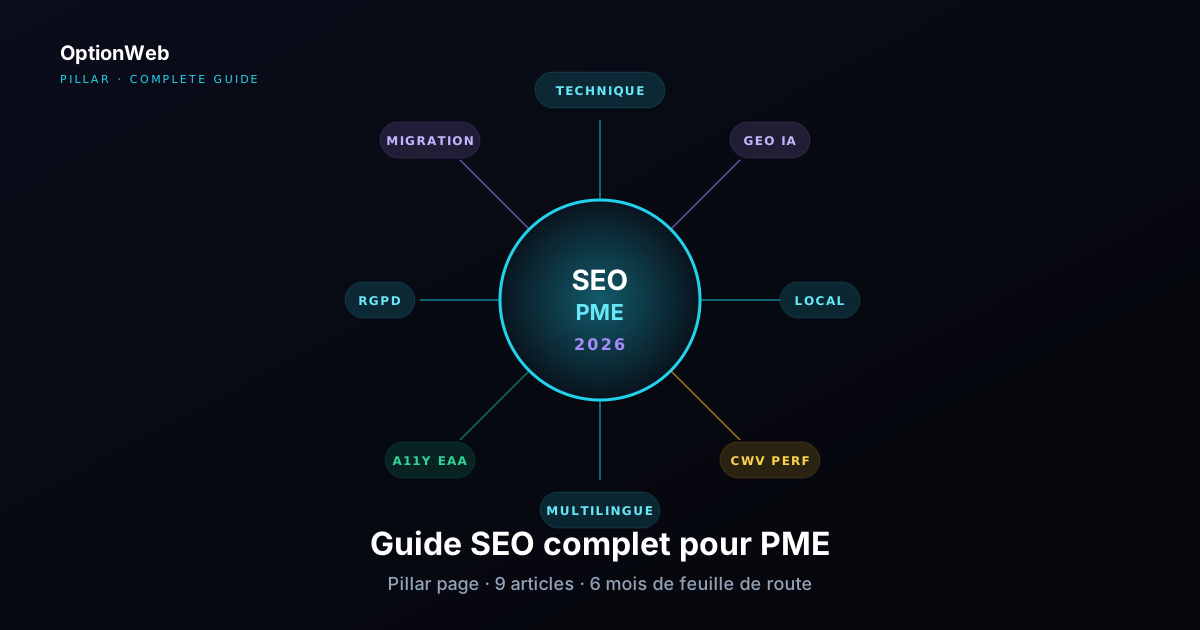
Complete SEO guide for SMBs in 2026: OptionWeb pillar page
Full map of SEO 2026 for SMBs: technical, GEO, local, multilingual, performance, accessibility, GDPR. Hub linking to the 9 deep-dive blog articles.
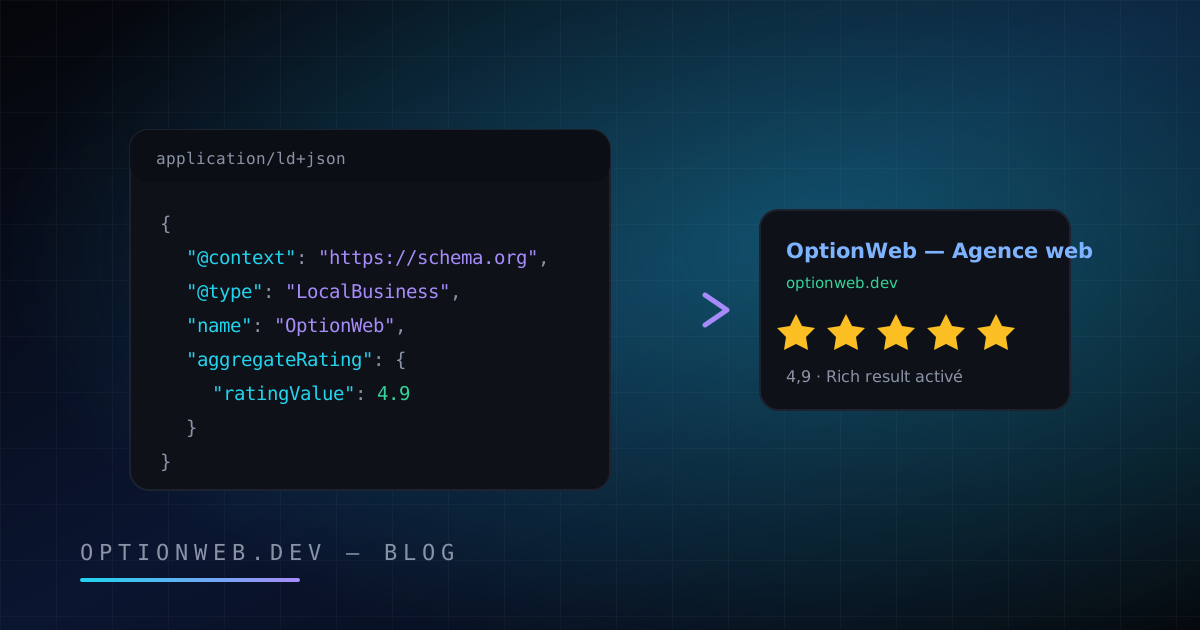
Schema Markup Guide 2026: Structured Data & Rich Snippets
Structured data and schema markup in 2026: JSON-LD, priority schemas for SMEs, complete code examples and testing. The practical guide from OptionWeb.
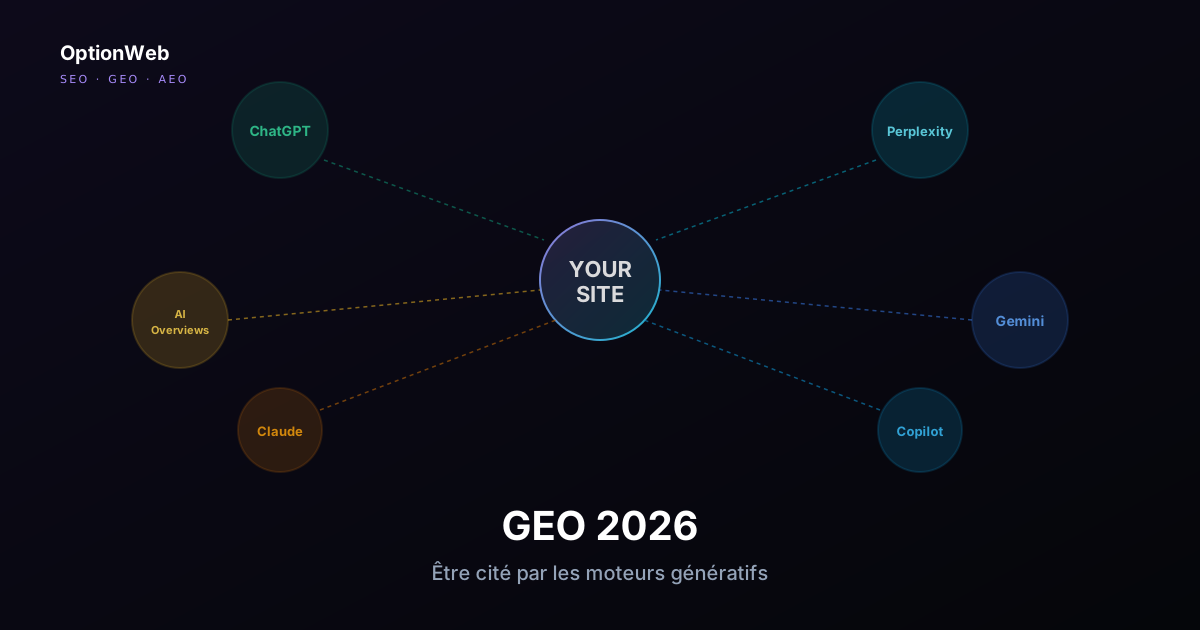
GEO in 2026: Getting Cited by ChatGPT, Perplexity and Google AI Overviews
Generative Engine Optimization: how to structure a site to be cited as a source by ChatGPT Search, Perplexity, AI Overviews, Gemini and Copilot. Concrete techniques beyond classic SEO.