Website Maintenance Cost in 2026 (Belgium Pricing)
In Belgium, website maintenance typically costs between €50 and €400 excl. VAT per month in 2026: €50-100 for a simple brochure site, €100-250 for a business site with content updates, €250-400 and up for an e-commerce store. A serious contract covers updates, security, backups, monitoring and support. An unmaintained site gets hacked, slows down and drops out of Google.

In Belgium, website maintenance typically costs between €50 and €400 excl. VAT per month in 2026. A simple brochure site can be maintained for €50 to €100/month, a business site with evolving content for €100 to €250/month, an e-commerce store or business-critical application for €250 to €400/month and up. The price depends on the technology, the frequency of interventions and the guaranteed level of support.
These ranges hide very different realities: some "maintenance contracts" boil down to clicking an update button once a month, while others include 24/7 monitoring, immediate security patches and content changes. This article breaks down what you are actually paying for, what a serious contract must contain, and what it costs to skip it altogether.
1. How much does website maintenance cost in 2026?
The Belgian market operates on three broad price tiers, directly tied to the complexity of the site and the scope of the service. Here are the ranges observed in 2026 among reputable agencies and freelancers:
| Type of site | Monthly range (excl. VAT) | What justifies the price |
|---|---|---|
| Simple brochure site (5-10 pages) | €50 - €100/month | Updates, backups, monitoring, minor fixes |
| Business site (blog, multilingual, forms) | €100 - €250/month | Same + content changes, priority support, reports |
| E-commerce / web application | €250 - €400/month and up | Same + post-update testing, critical availability, rapid interventions |
| One-off intervention without a contract | €60 - €120/hour | Billed per job, often as an emergency, with no response-time commitment |
Two billing models coexist: the monthly retainer (the most common, with a defined scope) and hourly billing (you pay for each intervention). The retainer is almost always the better deal once your site generates revenue: it turns an unpredictable risk into a fixed, budgetable cost.
The site's technology weighs heavily in the equation. A WordPress site with fifteen plugins requires frequent updates and testing after every pass: its maintenance is structurally more expensive than a modern static site that exposes neither a database nor an admin panel. It is a factor worth considering from the moment the site is built — we break down that full calculation in our guide to website costs in Belgium.
2. What does a website maintenance contract include?
A serious maintenance contract covers five pillars. If any of them is missing from the quote in front of you, ask about it before signing.
- Technical updates — CMS, plugins, theme, dependencies, server-side language versions. Applied after testing, not blindly pushed to production.
- Security — Critical patches applied as soon as they are released, vulnerability scanning, access hardening, monitoring of known exploits.
- Backups — Automatic, stored off-site (not only on the same server), and above all tested: a backup that has never been restored is an assumption, not a guarantee.
- Monitoring — Uptime and response-time monitoring, with automatic alerts when the site goes down — before your customers notice.
- Support and minor interventions — A defined contact channel, a stated response time, and a volume of routine changes (text, images, products) either included or clearly priced.
Depending on the budget, these pillars translate into three typical service levels on the Belgian market:
| Service | Basic (€50-100) | Standard (€100-250) | Premium (€250-400+) |
|---|---|---|---|
| Technical updates | Monthly | Monthly + immediate critical patches | Continuous, with regression testing |
| Backups | Weekly | Daily | Daily + regular restore tests |
| Monitoring | Uptime | Uptime + performance | 24/7 with alerts and intervention |
| Support | Email, reply within a few days | Email + phone, fast response | Priority, committed response time |
| Content changes | Not included | Monthly volume included | Extended volume + advice |
| Activity report | No | Monthly or quarterly | Detailed monthly |
3. Why does an unmaintained website eventually die?
A website is not a printed brochure: it is software running on infrastructure that never stops evolving. Without upkeep, three forces degrade it relentlessly.
Security first. WordPress powers a large share of the global web, which makes it the number one target for automated attacks. Bots scan the web around the clock looking for outdated plugins whose vulnerabilities are public and documented. A WordPress site left without updates for six months is not "at risk": statistically, it is already in the crosshairs. The hack does not target your business specifically — it targets your plugin version.
Then technical obsolescence. Server-side language versions reach end of life, browsers evolve, extensions abandoned by their authors stop working after a CMS update. A site left three years without maintenance often becomes impossible to update in one go: it then has to be rebuilt, at a cost bearing no relation to the upkeep that could have prevented it.
And finally SEO. Google measures the speed, availability and security of the sites it ranks. A slow site, one that is regularly down, flagged as hacked or riddled with broken links progressively loses its rankings — and winning them back takes months, as we explain in our complete SEO guide for SMEs. A "deceptive site" warning in Chrome, a classic consequence of a hack, instantly drives away visitors and prospects.
4. In-house, freelancer or agency: which should you choose?
A Belgian SME has three options for maintaining its website. Each comes with a different cost and risk profile:
| Criterion | In-house | Freelancer | Agency |
|---|---|---|---|
| Apparent cost | "Free" (employee time) | €50 - €150/month | €79 - €400/month |
| Real cost | Working hours diverted + risk of error | Fair if the freelancer is reliable | Fixed retainer, contractual scope |
| Security expertise | Rarely present | Varies by profile | Established processes, pooled threat monitoring |
| Service continuity | Depends on one person | Holidays, illness, career change | Team, guaranteed cover |
| Responsiveness during an outage | Unpredictable | Subject to availability | Contractual response time |
| Who is it for? | SMEs with genuine in-house technical skills | Small site, tight budget, trusted relationship | A site that generates revenue |
In-house maintenance is the most widespread false economy: it feels free because it never produces an invoice. In reality, it rests on one person who has another job, who applies updates without testing them, and who leaves one day taking the credentials with them. A freelancer is a valid option for a small site — provided you check what happens when they are unavailable. An agency looks more expensive, but it sells precisely what the other two options cannot guarantee: continuity and commitment.
5. The OptionWeb maintenance plans
At OptionWeb, we offer three maintenance plans, aligned with the three market tiers described above — with no nasty surprises about scope:
| Plan | Price (excl. VAT) | Who is it for? |
|---|---|---|
| Essential | €79/month | Brochure site: updates, backups, monitoring, email support |
| Professional | €199/month | Business site: Essential + regular content changes and priority support |
| Premium | €399/month | E-commerce and business-critical sites: Professional + enhanced follow-up and rapid interventions |
Let's be honest: if your site is a static business card that never changes and collects no data, the Essential plan is more than enough — and we will tell you so. Conversely, if one hour of downtime on your store costs you sales, the gap between €79 and €399/month pays for itself with the first outage avoided. The right contract is the one that matches what your site earns you.
6. How much does NOT maintaining your site cost?
The real comparison is not "€79/month versus €0", but "€79/month versus the cost of the first incident". Here is what the absence of maintenance actually costs when the problem hits:
- Post-hack cleanup — Expect to pay between €500 and €2,500 to identify the vulnerability, clean the code, restore a healthy state and get the Google warnings removed — assuming a clean backup still exists.
- Data loss — Without a tested off-site backup, a failing server or a destructive hack can wipe out years of content, orders and customer contacts. That content gets rebuilt at a steep price, or not at all.
- SEO collapse — A blacklisted or persistently slow site loses rankings earned over years of work. Recovery takes months, during which your competitors capture your prospects.
- Forced rebuild — A site that is technically beyond repair must be rebuilt: at OptionWeb, a new build starts at €2,890 excl. VAT. Three years of Essential maintenance cost less than a rebuild forced on you in an emergency.
- GDPR liability — A personal data breach caused by security negligence exposes you to notification obligations and penalties. The GDPR has applied since 2018, and negligence is not an admissible excuse.
The asymmetry is brutal: maintenance is a low, fixed, predictable cost; an incident is a high, sudden, uncontrollable one — and it always lands at the worst moment. It is exactly the logic of insurance, with one difference: here, the claim is all but certain in the medium term if nothing is done.
7. Monthly maintenance checklist
Whether you delegate or not, here are the ten checks a professional website should go through every month. It also works as a scorecard to assess what your current provider is really doing:
- Update the CMS, plugins, theme and dependencies — after verification on a staging environment if the site is business-critical
- Confirm that automatic backups have actually run, and test a restore at least once per quarter
- Review the monitoring report: monthly uptime, detected outages, response times
- Run a security scan and check for modified files or unknown administrator accounts
- Manually test the contact forms and, for an e-commerce store, the full checkout funnel
- Measure loading speed and Core Web Vitals on the main pages
- Check for broken internal and outbound links
- Review Google Search Console: indexing errors, reported security issues, abnormal drops
- Check the validity of the SSL certificate and the domain name's expiry date
- Verify that the legal notice, privacy policy and cookie banner are still compliant and working
Website maintenance: key takeaways
Budget €50 to €400 excl. VAT per month for website maintenance in Belgium in 2026, depending on the site's complexity and the service level. A serious contract covers five pillars — updates, security, tested backups, monitoring, support — with a written scope and a committed response time. And the profitability calculation is quick: a single hack or a single data loss costs more than years of retainer fees.
Has your site been running without a safety net for months, or does your current contract look like the "empty retainer" described above? Our Essential (€79), Professional (€199) and Premium (€399/month excl. VAT) plans cover all five pillars, on Belgian infrastructure we control end to end. Tell us about your site and request a free quote: a reply within 48 hours, and an honest opinion on the plan you actually need — not the most expensive one.
Read next
How much does a professional website cost in Belgium in 2026?
Pricing guide: honest ranges for brochure sites, e-commerce, SaaS, custom builds. Quote breakdown, hidden costs, freelancer vs agency, real ROI and transparent pricing grid.
Belgian web hosting in 2026: the complete guide for SMBs
How to choose a Belgian web host in 2026 — selection criteria, real costs, GDPR compliance, local datacenters, performance. Practical guide by OptionWeb.
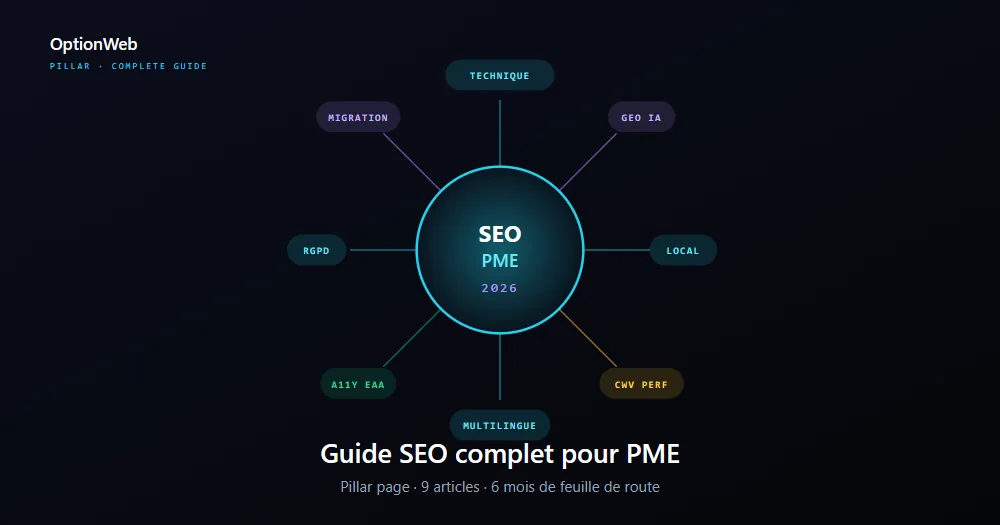
Complete SEO guide for SMBs in 2026: OptionWeb pillar page
Full map of SEO 2026 for SMBs: technical, GEO, local, multilingual, performance, accessibility, GDPR. Hub linking to the 9 deep-dive blog articles.